Showing posts with label tips. Show all posts

Wednesday, October 5, 2011

Humidity: It's All Relative

     *Relative humidity* is the amount of moisture in the air compared to what the air can "hold" at that temperature. Technically, air doesn't "hold" water. It has to do with vapor densities, and thermal /barometric changes. As air temperature and pressure changes, it's relative humidity changes. 
     Although cannabis is a hearty plant, for the best medicinal results, keep your humidity in the plants' optimal range.  This range varies depending on the stage of growth that your plants are in. Here is a list of ideal humidity ranges for different life stages of cannabis:


80-90% - ROOTING CLONES AND CUTTINGS

60-70% - VEGETATIVE GROWTH

40-60% - FLOWERING


Higher humidity is needed for your precious babies as they do not have the root support to obtain the proper amount of water from their grow medium.  When your plants bud, too much moisture can accumulate in  the clusters of buds. Lowering the humidity helps control mold and other fungal contaminants from developing on your plant.  
     I caution you to not be reckless and go all "Death Valley" on your growroom.  Too little moisture will stress your plants!  However, I have heard of some growers deliberately stressing their plants by drastically dropping the humidity during the final few days before harvest to increase resin production. They claim that the  resin acts as the plant's natural "moisture-lock" on the buds in an attempt to protect the flowers for future pollination.  Little does the plant know that pollination is not in its future! 

Monday, September 12, 2011

Mycorrhizae for Better Cannabis!

     Myco-what?  Many people who grow their own cannabis do not realize that they may be missing out on a great way to protect and strengthen their plants from the roots up.  Lo and behold, mycorrhizae!  *Mycorrhizae* are colonies of fungi symbiotically joined with root systems of plants - each providing unique benefits to the other.
     The picture here shows a root system of a seedling on the left prior to inoculation while the shot on the right shows the mycorrhizal symbiosis.  The fungi act as "webbing", allowing the plant to grab much more water and nutrients from the surrounding soil. The plant in return provides sugars as a food source for the fungi.
     Mycorrhizae provide protection to the symbiotic plant as well.  Scientists have found that mycorrhizal fungi provide superb soil remediation by guarding the plant roots from pollutants such as heavy metals and other inorganic toxins.  Plants are also more disease-resistant and handle environmental stresses such as drought much better.
     When shopping for mycorrhizal fungi, make sure you look for endomycorrhizae - NOT ectomycorrhizae.  This is important if you do not like spending money for nothing.  While "endos" actually bind internally with the plants roots, "ectos" do not.  Certain plant species only benefit from one or the other.  Cannabis has been found to only respond to the endomycorrhizae.
     I hope this can be a help to those trying to grow the best medicine possible.  The Internet is a great tool for further research.  Also, message me with further questions and I will be glad to answer them.

Monday, August 29, 2011

Lumens and the Inverse Square Law

     Plants need light.  Unfortunately for growers, it is not quite that simple. The wattage needs to be perfect.  The timing of the lights has to be perfect.  The color spectrum must be perfect. And then there is something called a *lumen*
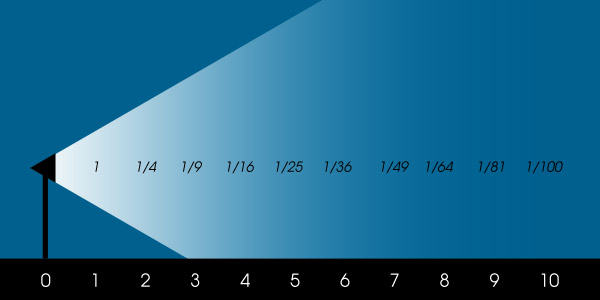
     The typical indoor cannabis grow room  requires about 50,000 lumens. In comparison, the sun gives off over 6.8 octillion lumens! that huge number is cut down to size when we consider the distance that the sun's light has to travel - 93 million miles. This leads me to the Inverse Square Law...  It goes something like this: as the distance is increased, the intensity is decreased by the inverse square of the distance. Huh?  Let me break it down. Let's say in our imaginary room, our light source is one foot away. This light is putting out 1,000 lumens. If I multiply the distance by two (now making it two feet away), I have decreased the light intensity by the inverted square of two - one-fourth. If I multiply my distance again by two (now putting me at four feet), my plants will only be receiving one-sixteenth of the original amount of lumens. Not cool. 
     Growers have been combating the effects of this law for years with reflective hoods on their bulbs and/or keeping the lights as close to the plants as possible - without frying them of course. Many growers paint their grow rooms white for added reflectivity.  I present to my blog readers an idea that may give more lumens for less money...  Turn your grow room ceiling into a giant reflective "wing"!
     A standard flat ceiling, even if coated with reflective material, doesn't give the optimal angles for light reflection. Going back to the Inverse Square Law, one should understand that the more times light bounces from one surface to another, the farther the light is traveling, creating a huge drop in the lumens.  With a curved, wing-like design, your grow room ceiling can angle the rays of lights from it to the plants in one reflective bounce instead of numerous bounces (from the ceiling to the adjacent wall, to the opposite wall, and finally hitting the plants).  With the right angles, your grow room could have the perceived brightness of a 1000 watt setup with only 600 watt bulbs... 
     The trick to getting the most out of the reflection is to think geometrically.  Using a standard flashlight (or better yet, a laser pointer) positioned where your grow lights will be, shine your light at your standard ceiling and notice how it reflects.  Construct a panel with plastic or cardboard covered with Mylar film and have someone hold it to the ceiling and adjust the angle of it - while shining your light on it - until the light is reflecting directly at the location of your plants. With some time and ingenuity, you could be capturing the "wasted" light and sending it straight to where it needs to be - on your plants and not on the walls!
     Now, back to the sun issue. If you grow outdoors, the Inverse Square Law doesn't play as huge of a role because the relative distance between heights on our planet and the overall distance form the sun is so great that the lumen differential is too minute to make a difference.  
     Although maybe a little too technical for some, I hope this can be a huge help for growers, newbies and veterans alike.  I certainly look forward to additional tips and tricks for growers in the upcoming weeks and months. I conclude with a reflectivity chart on various materials:
Reflectivity in %
- Reflective plastic sheet (Mylar) 90-95
- Gloss white paint 85-90
- Semi-gloss white paint 75-80
- Gloss yellow paint 70-80
- Aluminium foil 70-75
- Black paint less than 10